
Lighting Up the Ranch for the Next Generation of Agriculture
Don Cameron explains why he is betting on on-farm connectivity and automated valves to keep Terranova Ranch sustainable in a regulated future
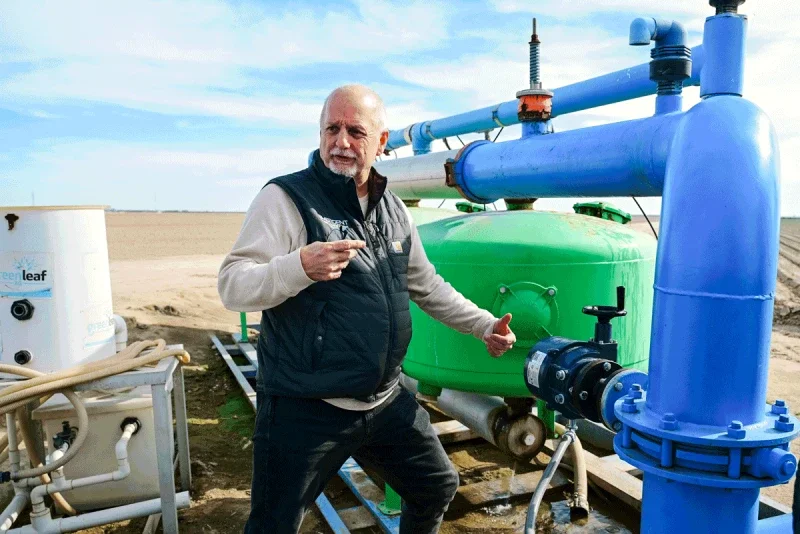
Emergent’s dashboard helps Terranova Ranch track irrigation on the ranch’s 2,200 acres of processing tomatoes, reducing labor and vehicle use, says Don Cameron, vice president and general manager of Terranova Ranch. Pictured is Greg Jarman, Emergent’s co-founder and chief technology officer, at Terranova Ranch.
Connectivity is a significant hurdle to the future of smart farming, says Don Cameron, vice president and general manager of Terranova Ranch. He says he’s wanted to add Wi-Fi and connected devices for a long time to better automate farm tasks, especially irrigation.
Once Cameron started working with high-speed internet service provider Cal.net, he began to explore broader implications of smart farming at Terranova Ranch. Later, he connected with Emergent, an ag tech company that provides an automation platform for the ranch.
Taking Manual Work Out of the Field
Cameron says that Emergent’s dashboard helped Terranova track irrigation on the ranch’s 2,200 acres of processing tomatoes instead of crews manually operating valves.
“We had guys going around every seven hours or eight hours, opening and closing valves to irrigate subsurface drip irrigation on tomatoes,” he says. “For every 75 acres, we have three valves.”
Cameron says this system is critical as groundwater management becomes a greater focus in farming in California. He says Terranova has specific allocations on groundwater use, so there are accurate records of irrigation as well as even applications.
“We’re seeing allocations on how much groundwater we can pump in certain areas here, and so being able to use water efficiently is really imperative for us,” he says. “As we move forward with groundwater management, it’s going to become extremely important.”
Cameron says Terranova benefits not only from accurate irrigation records through this precision irrigation application, but he’s also seen reduced labor and vehicle use.
“We can change the irrigation schedule from a phone. We do deficit irrigation as we approach harvest, so we can make these changes relatively easily,” he explains. “We can get better-quality crops, higher-yielding crops, and save water. We can irrigate during off-peak periods with electricity.”
Cameron says all of this is critically important as water use is the No. 1 issue California growers face. The more information he has on water usage, distribution and more, the better, he says.
“The more information we have, the more data we have on our water usage and even what’s going on with our wells, our pumping,” he says. “To me, that data is going to be even more important in the future because of the regulations we have here in California and how valuable water really is.”
Cameron says Terranova farms in four groundwater sustainability agencies, which have slashed the amount of water allocated.
“Next year, they’re cutting the amount of water to be pumped from the underground to 1 acre-foot per acre,” he says. “And a crop of tomatoes typically takes 2.5 acre-feet. Almonds could use as many as 4 acre-feet. So, you understand really quickly how important data is when we’re talking about exactly about water and crops that we can grow for the future and planning for the future.”
Building a Digital Paper Trail for Compliance
Cameron says Emergent’s platform has opened the door to where he can monitor much more of the farm beyond the irrigation.
Smart farming’s reach extends to well monitoring with AgMonitor and electronic timecards on workers’ phones, both of which he says are to stay in compliance with regulatory issues. Workers clock out for breaks, and having that electronic record is critical.
“If we ever get an issue with labor and proving our guys took breaks at the right time, believe me, this is a really important thing to have,” he says.
The timecards feed into Terranova’s payroll program, which has eliminated some manual work, Cameron says.
He also uses fixed-wing photos that take NDVI images to show moisture stress.
“This gives us assurance of what we’re doing with our irrigation,” he says.
Cameron has also placed trackers on Terranova’s sprayers, which helps monitor efficiency (and inefficiencies) on the ranch.
“We know if they miss a row,” he says. “We know how long it takes them to fill the sprayer, and if they’re spraying or if they’re screwing around.”
Vetting the Next Wave of Technology
Cameron says crop selection, in light of potential water use restrictions, will play a bigger role in the future of agriculture in California.
“They’re going to have to use conservation measures, and they’re going to have to use their water much differently than they have in the past,” he says.
Cameron, who has been a pioneer in groundwater recharge, says it’s critical to renew aquifers and prevent downstream damage during flooding.
Cameron switched to subsurface drip irrigation in 2009, and he says he saw not only water savings but better yields.
Connectivity also will play a major role in the future of agriculture, but he says there’s still much work needed in improving rural access.
“What we’re doing now, I think with IoT [internet-of-things] technology, I think is going to be really helpful long term,” he says.
Cameron has also experimented with automated weeders. The challenge with automated weeders, however, is that they have to pencil out in terms of speed and cost, he explains.
“What I’d love to see in the future is more automation in weeding, better technology, faster technology and lower-cost technology,” he says.
Cameron also hopes the future brings more integration of CRISPR technology with built-in disease resistance, “along with other new traits to make what we grow more flavorful, healthier, and more resilient,” he adds.
As for being a pioneer in the integration of technology, Cameron says he views taking a chance as being critically important.
“Sometimes you just have to say, ‘Look, we’re going to try this, and hopefully it’s going to work well, and let’s get behind it and give it a chance, and it solves a problem that we have,’” he says. “Typically, what happens is it works out well, and if it doesn’t, we stop.”
Source: thepacker.com
